

View Collections | Browse Cultural Objects | Browse Oral History

Images (click to enlarge)
-
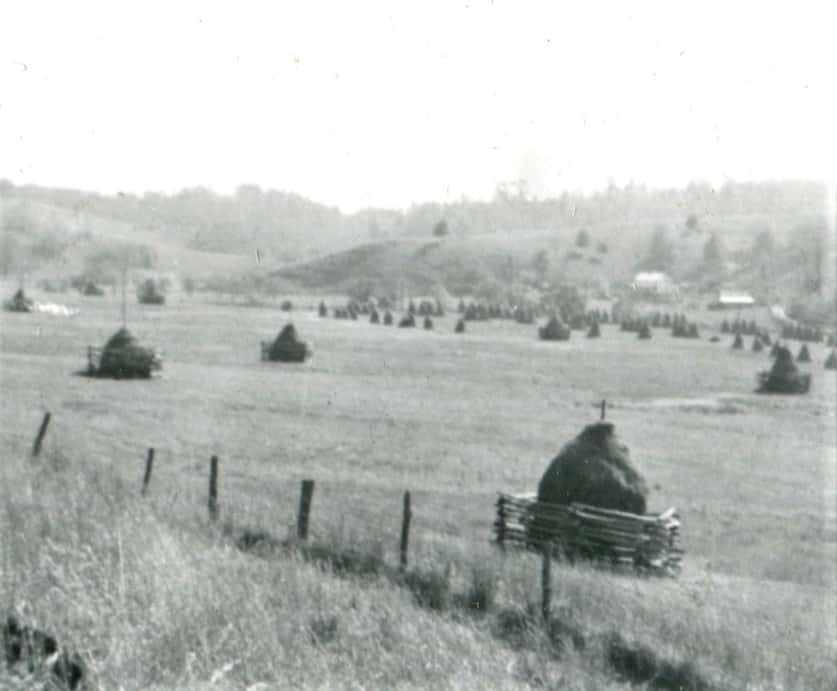
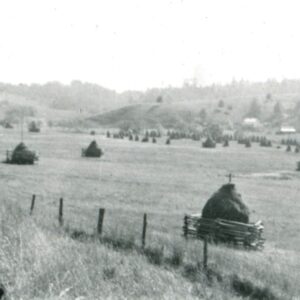 This 1951 photo shows the last hay stacks built by Freeman Slusher's family in their Dairy Meadow. The following year Freeman and his brother George Slusher purchased a square baler to use on their adjoining Laurel Branch Road farms. Smaller corn shocks are also visible in the background.
Cultural Objects, Tools
Hay Fork
People
Associated Person: John Adam HarterDate
1850-1890Places
Black Ridge (Courthouse District)Material/Medium
Iron, wood
Specifications
- Length of handle: 8 feet
- Length of fork tines: 12 inches
- Width of fork tines: 7 inches
Description
This three-tined fork is forged of iron and bolted to a long wooden handle. It is designed specifically for building a hay stack. Before square balers came into use, farmhands would slide two poles under loose rolls of hay, called shocks, and carry them to the location of the stack. These shocks would be arranged around a stack pole already planted in the ground, forming a base layer roughly fifteen to sixteen feet in diameter. As more shocks were added, one person stayed on top of the stack tramping the hay to make it as dense and watertight as possible. Hay forks were used to lift shocks into place as the stacks got higher and to smooth the sides of the stacks. The long handle of the fork also came in handy if the person doing the tramping (often a child) needed something to hold when sliding down from the completed stack. Someone on the ground would extend the fork’s handle and stand ready to catch the child on the way down.
Keywords
Hay fork, hay stack, hay shockBio Sketch
John Harter (1825-1909) and his wife Harriet Howell Harter brought up nine children on their Black Ridge farm. Women and children generally helped with haying and after John Harter lost a leg during the Civil War, his family would have taken on tasks that he no longer could do. He was known for the furniture and baskets he made. See his coiled straw dough tray in our Basket collection.