“Consider the Lilies”
Recording of ten gospel songs by the Hylton family of Floyd County.



Recording of ten gospel songs by the Hylton family of Floyd County.

This quilt left Floyd County in 1922 when its owner Zora Weeks Slusher moved to North Dakota.

Crazy quilt incorporating more than nineteen different embroidery stitches.

Oral histories of musicians and dancers who entertained visitors to Mabry Mill on the Blue Ridge Parkway.
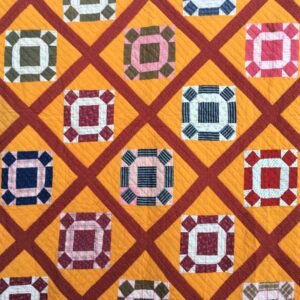
Arlie Harman Tobler was thirteen years old when she completed this bright and complex quilt.

Bricks used by Henry Dillon in building the second Floyd County courthouse which replaced the original 1832 structure.

Beginning in the early 1900s, cooperatives formed to bring telephone service to selected communities in the county.
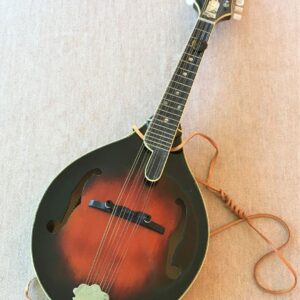
Hansel Roberson crafted this mandolin using curly maple for the sides and neck.

Bed passed down in the Aaron and Ada Altizer Family.

Smithsonian survey that includes seven sites in Floyd County.
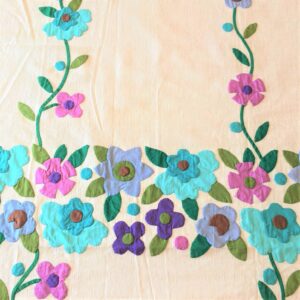
Alice Peterman Tise created this summery table covering for use in her home on Oxford Street.

Market basket passed down through the Alderman/Vaughn family.

One of two rhinos Andy Hylton fashioned from the root of a downed tree.

“Charm” quilt created by Nancy Jane Shank using more than two hundred unique feed sack prints.

Operators working out of their homes connected callers manually in the early years of telephone service.
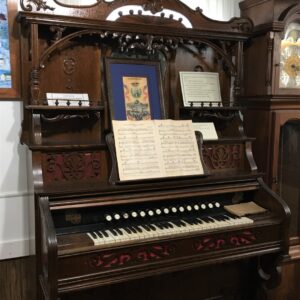
Tricentennial model parlor organ available through the Sears, Roebuck and Co. catalog.
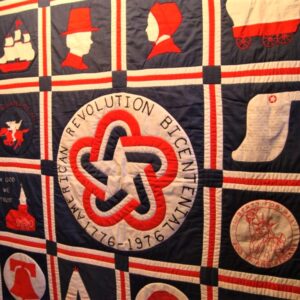
Commemorative quilt completed by Elzada Boothe in 1976.

Craftsman style chair built by the Rev. J.M. Tise.

When blacksmith Shep Alderman needed a tool to measure a wagon wheel for spokes, he carved his own.

The unknown maker of this quilt appliqued and embroidered twenty-four blocks of flowers for this quilt.
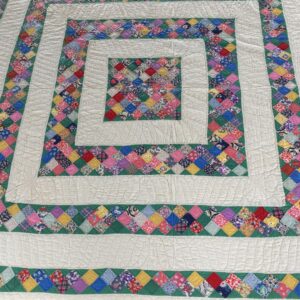
This pattern quilted by a member of Jessie Tise Heafner’s family is also known as “Garden Path.”

Two little girls enjoyed this doll furniture carved by their great-uncle Hines Sutphin.

Rainbow colors forming a dazzling bedcover donated by Jessie Tise Heafner.
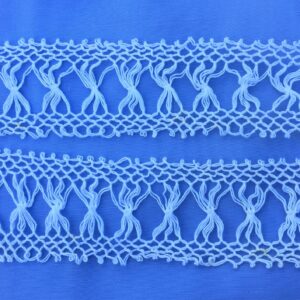
Also called “jiffy” lace, this crocheting technique uses a broomstick in addition to a crochet hook.