

Archaeology
Old Church Gallery’s most ancient collection is made up of both prehistoric and historic objects. Each wave of people coming to these mountains left behind material clues of their existence and industry. The hunter-gatherers from the Archaic Period (8000 to 1600 BC) found that our native soapstone, quartz, and chert could be shaped into essential tools for building shelter as well as obtaining and preparing food. Ceramic pottery sherds indicate people were gardening and storing crops in the area as early as the Woodland Period (1600 BC to European settlement).
English, Scots-Irish, and German settlers arriving in the late 1700s and early 1800s rediscovered prehistoric quarry sites and pocketed Native American projectile points from their corn patches after plowing. They, in turn, left artifacts that help us imagine their lives. Crockery and glass fragments in old gardens, foundation stones, and rusting pieces from long abandoned farm machinery are objects of historical archaeology and connections to the lives of our ancestors.
In 1998, Mrs. Minnie Young Sweeney donated her husband Thomas Strickler Sweeney’s Native American artifact collection to Old Church Gallery. Strick Sweeney spent decades searching plowed fields on his and neighboring farms in Alum Ridge as he built this collection consisting of more than 1,000 pieces. Most of these artifacts have been classified with the assistance of Dr. Cliff Boyd, Radford University.
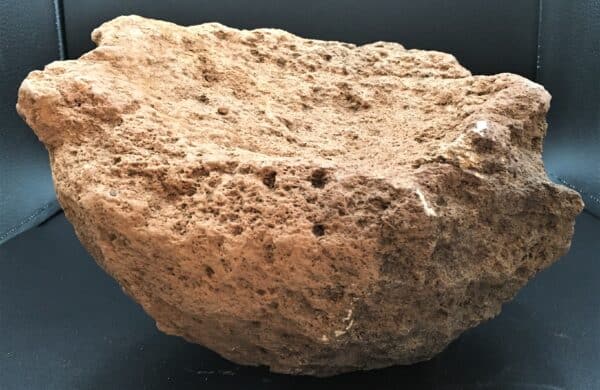
This prehistoric bowl fragment was found near a known soapstone quarry site in Floyd County. This site is one of several in the county known to have been used by prehistoric peoples and rediscovered by settlers in the 1800s.